
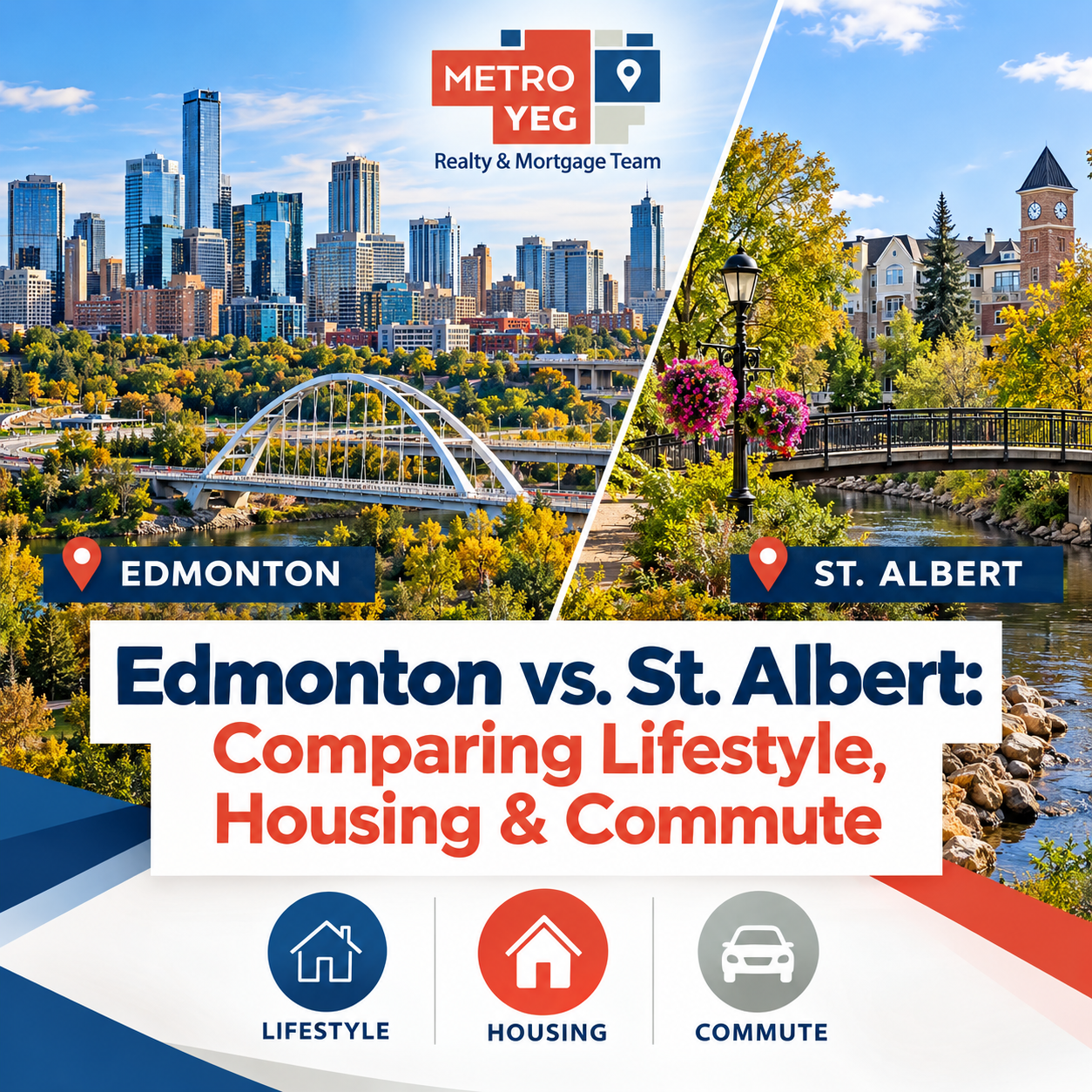
Choosing between Edmonton and St. Albert often comes down to lifestyle, housing preferences and your daily commute. Edmonton offers more neighbourhood variety, employment centres, entertainment and transit options, while St. Albert appeals to buyers looking for a smaller-city atmosphere, extensive trails and parks, and convenient access to northwest Edmonton.
Neither is automatically the better place to buy a home. The better choice is the one that fits your budget, commute and how you actually want to live.
Edmonton vs. St. Albert at a Glance
For buyers comparing the two communities, here are some of the biggest differences to consider:
The right choice depends less on the city name and more on the specific neighbourhood and property.
Lifestyle: Big-City Convenience or Smaller-City Feel?
One of the clearest differences between Edmonton and St. Albert is the overall feel.
Living in Edmonton
Edmonton gives buyers an enormous range of lifestyles within one city.
You could choose an established central neighbourhood with mature trees and character homes, a condo close to Downtown or Whyte Avenue, a suburban family community, or a newer home on the edge of the city.
That variety can be especially valuable if you want to live close to work, restaurants, shopping, entertainment, post-secondary institutions or Edmonton's river valley.
Edmonton also has hundreds of neighbourhoods, so two Edmonton homes with similar prices can offer very different lifestyles.
If you're new to the region, our Moving to Edmonton & Area guide can help you compare neighbourhoods based on your commute, budget, home style and priorities.
Living in St. Albert
St. Albert provides a different experience. It is its own city rather than an Edmonton neighbourhood, but it sits directly northwest of Edmonton and is closely connected to the Edmonton metropolitan area.
One of St. Albert's biggest lifestyle attractions is its park and trail network. The Red Willow Trail System covers approximately 99.5 kilometres and connects neighbourhoods with major parks and other areas throughout the city.
St. Albert also offers recreation facilities, local shops and restaurants, the Perron District, parks and established neighbourhoods, along with newer residential development.
For buyers who like having Edmonton nearby but prefer a smaller community setting, St. Albert can be an excellent option.
Housing: What Can You Buy in Edmonton vs. St. Albert?
This is where the comparison becomes more individual.
Edmonton Housing
Because Edmonton is much larger, buyers generally have more housing types and neighbourhoods to choose from.
Depending on your budget and location, options can include:
Downtown and suburban condos
Townhouses and duplexes
Older detached homes on mature lots
Renovated character homes
New infill properties
New construction in developing communities
Luxury and estate properties
That variety can make Edmonton particularly useful for buyers with a specific price range or housing style in mind.
Explore our Edmonton & Area communities to compare different areas and lifestyles.
St. Albert Housing
St. Albert also offers a good mix of established and newer communities, but on a smaller scale.
Buyers can find everything from older homes in mature neighbourhoods to newer detached homes, townhouses and other properties in developing areas.
Rather than assuming that Edmonton or St. Albert is always more affordable, compare similar homes in similar types of neighbourhoods. Lot size, age, renovations, garage, location and property type can dramatically affect value.
You can learn more about the community and available housing on our St. Albert homes and real estate page.
What About Property Taxes?
Property taxes should be part of the comparison, but looking at a tax rate alone can be misleading.
Property taxes are based on assessed values and the applicable municipal and provincial components. Alberta's education property tax also forms part of residential property taxation.
For example, Edmonton publishes its annual residential property tax rates and provides an online property tax estimator. St. Albert similarly establishes its municipal tax requirements and rates each year.
When comparing two actual homes, look at the property's current tax bill, not simply a general assumption that one municipality has higher or lower taxes.
For more information, buyers can review the City of Edmonton's property tax information and the City of St. Albert's assessment and taxation resources.
Commute: Is St. Albert Too Far From Edmonton?
Not necessarily — but where you work in Edmonton matters considerably.
Someone working in northwest Edmonton may find living in St. Albert extremely convenient. Someone commuting every day to south or southeast Edmonton will have a very different experience.
If you're considering St. Albert, think about your actual destination rather than simply measuring the distance to "Edmonton."
Consider:
Where do you work?
A commute to northwest Edmonton is different from travelling Downtown, to the University of Alberta or to south Edmonton.
When do you commute?
Rush-hour conditions can make the same route feel very different at different times.
How often do you commute?
Someone working from home three days per week may view an additional drive very differently than someone commuting twice every weekday.
Do you use transit?
Edmonton's transportation network includes bus and LRT service. St. Albert Transit also provides service within St. Albert and to key Edmonton destinations, including weekday express commuter routes serving Downtown Edmonton.
For buyers choosing between the two cities, we recommend testing the commute from specific neighbourhoods you're considering during the time of day you would actually travel.
Parks, Trails & Recreation
Both cities have excellent outdoor amenities, but they offer different experiences.
Edmonton's size provides access to a huge range of parks, recreation centres, neighbourhood amenities and the North Saskatchewan River Valley.
St. Albert's smaller scale can make its interconnected green spaces particularly appealing. The City reports more than 515 hectares of parkland, and its Red Willow Trail System connects many neighbourhoods, parks and urban areas.
For someone who prioritizes walking, running, cycling or easy access to community recreation, this can be a significant factor when choosing a neighbourhood.
What About Families?
Both Edmonton and St. Albert have communities that can work very well for families.
Rather than choosing based solely on the municipality, look closely at the individual neighbourhood.
Consider things such as:
The specific schools that serve the address
Parks and playgrounds
Recreation facilities
Daycare and childcare needs
Distance to work
Shopping and everyday amenities
Housing costs
Property taxes
Future space requirements
If a particular school is important to your decision, always confirm current attendance boundaries and eligibility directly with the applicable school board before purchasing.
Edmonton May Be a Better Fit If...
Edmonton may make more sense if you want maximum choice in neighbourhoods and housing types, need convenient access to a particular part of the city, rely heavily on Edmonton transit, or want to be closer to major employment, entertainment and post-secondary destinations.
It can also be easier to fine-tune your home search because there are so many different neighbourhoods and property types available.
St. Albert May Be a Better Fit If...
St. Albert may stand out if you prefer a smaller-city atmosphere, value parks and interconnected trails, work in northwest Edmonton or St. Albert, or simply prefer the housing and neighbourhood options you find there.
For some buyers, being close to Edmonton while living in a separate, smaller municipality offers the balance they're looking for.
So, Should You Buy in Edmonton or St. Albert?
The best way to answer the Edmonton vs. St. Albert question is to compare specific neighbourhoods and specific homes, rather than the two cities in general.
A buyer who works Downtown, wants a character home and loves walking to restaurants will have very different priorities from someone who works in northwest Edmonton, wants a newer detached home and spends weekends on trails with their family.
Start with four questions:
What is your comfortable monthly housing budget?
Where will you commute most often?
What type of home do you want?
Which lifestyle features would you use every week?
Once those answers are clear, the decision usually becomes much easier.
Our MetroYEG Realty & Mortgage Team combines Edmonton & Area Realtors and Alberta Mortgage Brokers, so we can help you compare communities, homes, financing and overall monthly costs together. If you're still establishing your budget, starting with a mortgage pre-approval can help narrow the search before you start touring homes.
Frequently Asked Questions
Is St. Albert more expensive than Edmonton?
It depends on the property and neighbourhood being compared. Edmonton has a much larger and more diverse housing market, while St. Albert has its own mix of established and newer communities. Compare current listings and recent comparable sales for the type of home you actually want rather than relying on a city-wide average.
Is St. Albert a good place to live if I work in Edmonton?
Yes, it can be. St. Albert borders northwest Edmonton, making some Edmonton workplaces relatively convenient. Your commute will depend heavily on the location of your workplace, time of day and neighbourhood you choose.
Does St. Albert have public transit to Edmonton?
Yes. St. Albert Transit provides service to key Edmonton destinations. Its weekday express commuter routes include service to Downtown Edmonton, MacEwan University, Government Centre and Edmonton City Hall.
Is Edmonton or St. Albert better for families?
Both can be excellent choices. The better fit depends on the specific neighbourhood, school requirements, commute, budget, parks, recreation and type of home your family needs.
Should I get mortgage pre-approved before deciding between Edmonton and St. Albert?
Yes. A mortgage pre-approval can help establish a realistic price range and make it easier to compare homes and neighbourhoods in both cities. Remember that a pre-approval is not final mortgage approval; the lender must still approve the borrower and the property.


